Beyond the Sale Price: 5 Non-Financial Factors That Define a Successful Exit
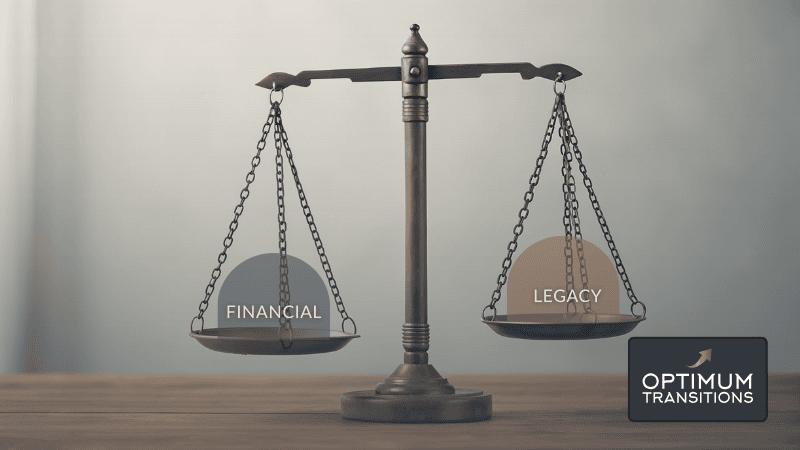
When you've spent decades building a business, it's natural to focus on the bottom line. But here's what we've learned from working with hundreds of business owners: the most satisfied sellers aren't always the ones who got the highest price. They're the ones who got the best outcome.
»That's the difference between focusing on the transaction vs. the whole transition—and it's at the heart of everything we do at Optimum Transitions.
It Doesn't Have to Be Either/Or
Let's be clear: we're not suggesting you leave money on the table. Financial success matters. But the owners who feel genuinely confident about their exit aren't agonizing over percentages. They're the ones who negotiated for outcomes that actually matter to them.
Research backs this up. According to Project Equity, 54% of business owners believe ensuring their business continues to operate successfully is more important than maximizing financial returns. Over half prioritized preserving their legacy and values over pure financial gain.
This isn't about settling for less. It's about defining success on your own terms—and making sure your deal delivers it.
The 5 Non-Financial Factors That Matter Most
Here are the factors that most often determine whether an owner looks back on their exit with satisfaction:
»Your business is a reputation you've built, a culture you've cultivated, and a mission that matters to your community.
Legacy preservation means ensuring it doesn't get dismantled after you step away.
This includes your company's values, brand identity, and community contribution. For community-focused businesses, this is non-negotiable. A buyer who gets the financial deal right but dismisses your values creates a hollow victory. A buyer who honors your legacy helps make the entire transition meaningful.
»The people who built your business with you deserve more than a footnote in the transition announcement.
When evaluating buyers, ask: Will my long-term employees keep their jobs, benefits, and sense of belonging?
One powerful approach is ESOP creation. ESOP-owned companies demonstrate this principle clearly: they show lower turnover, stronger engagement, and better performance. When employees are owners, they protect both legacy and livelihoods. For many of our clients, protecting their team is just as important as protecting their proceeds—and smartly structured deals achieve both.
»A successful exit requires transferring knowledge, relationships, and vision—not just ownership.
A clear post-sale leadership plan isn't just good for continuity—it's also attractive to serious buyers and gives you more options.
This is one of many reasons why we recommend starting exit planning 5-10 years in advance. It gives you time to develop the leadership bench strength that buyers want and that ensures continuity when you step away.
»Especially for locally-rooted businesses, community impact is central to your identity.
This can include local ownership and operation, charitable involvement, and economic contribution.
Communities benefit significantly from the stability of locally owned businesses. Increasingly, buyers recognize this value. This is especially true for ESOP transactions and management buyouts, where local continuity is a core benefit.
»Many owners experience an "exit identity crisis." After decades as "the owner," who are you next?
According to the Exit Planning Institute (2023), 42% of owners plan to retire, 39% intend to invest in another business, and 31% want to pursue philanthropy. Research shows that owners who focus only on the transaction often experience regret. The owners who thrive are those who thoughtfully planned for what comes next.
The question is crucial: What will you do after the sale? The most satisfied sellers have intentionally designed what comes next—ensuring they're not lost when the business moves on without them.
A Framework for Making the Right Decision
At Optimum Transitions, we've developed a comprehensive planning tool—our Goals & Objectives Worksheet—that helps you clarify what truly matters before you start. It walks you through your personal objectives, financial goals, how you'll use proceeds, who you want to protect, and your vision for what comes next.
Here's how we guide owners through balancing financial and non-financial priorities:

Clarify your non-negotiables first
Before entertaining any offers, know what truly matters to you. Is it legacy preservation? Employee protection? Community continuity? Your personal post-exit vision? Other factors? Write them down. Be specific.

Score potential buyers against your criteria
A buyer who offers premium pricing but threatens your values isn't actually premium if you'll regret the sale. Better yet—identify the buyers who genuinely align with your values and negotiate them to market price. Many will move there because they see the real value.

Recognize Non-Financial Factors as Real Economic Value
A buyer who respects your values and protects your legacy often benefits from lower risk, better employee retention, and smoother transitions. These translate to real economic value—and savvy buyers know it. Use this to your advantage.

Plan your next chapter actively
Don't let the exit define your life after the business. Invest time in exploring what comes next. Some of the happiest sellers we know spent as much time planning their retirement, new venture, or philanthropic goals as they did planning the sale itself.
And here's something crucial: getting clear on why you're exiting matters. We often find that owners' real goals can be accomplished without a full exit—sometimes a partial sale, ESOP, or management buyout serves them better.

Document Agreements that matter
Protecting your legacy requires more than a purchase agreement. Build in mechanisms that keep your values embedded in how decisions get made post-sale. Your advisor should help you think through what that looks like for your situation.
The Optimum Approach: Win-Win-Win Outcomes
At Optimum Transitions, we believe the best deals create value for everyone—the selling owner, the acquiring party, and the business itself. We don't transact; we transition. We start by asking what success actually looks like for you, then structure a deal that delivers it.
Your legacy matters. Your employees matter. Your community matters. And so does your financial security. A great exit addresses all of these—not as compromises, but as complementary outcomes that reinforce each other.
When you work with us, we start by asking what matters: What are you really trying to accomplish? What do you want to see continue?
From there, we evaluate options through a values-based lens. We look for buyers who genuinely align with your mission. We structure deals that protect what matters.
»Your transition should reflect your values, protect your legacy, and position you for genuine success on your own terms.
The Bottom Line
A successful exit isn't about maximizing one number—it's about getting the right outcome.
You deserve fair compensation for decades of hard work. And interestingly, the owners who feel genuinely satisfied aren't those obsessing over incremental gains—they're the ones who negotiated for what actually matters: a buyer who respects their legacy, protects their employees, and preserves community impact.
They're not competing goals. A buyer who aligns with your values typically represents a better long-term investment for them too. That's what creates a true win-win-win.
Ready to clarify your goals?
Explore what a values-aligned transition looks like for you. Start with our free Goals & Objectives Worksheet—a tool we use with every client.
Then, let's have a confidential conversation about your options and vision for the future.